
LEWIN’S CHANGE MANAGEMENT MODEL
A timeless three-stage blueprint for lasting organisational transformation

The well-known social psychologist Kurt Lewin is frequently referred to as the “father of social change theories.” His Change Management Model offers a fundamental view of change that is still applicable and frequently used in a variety of organisational contexts today.
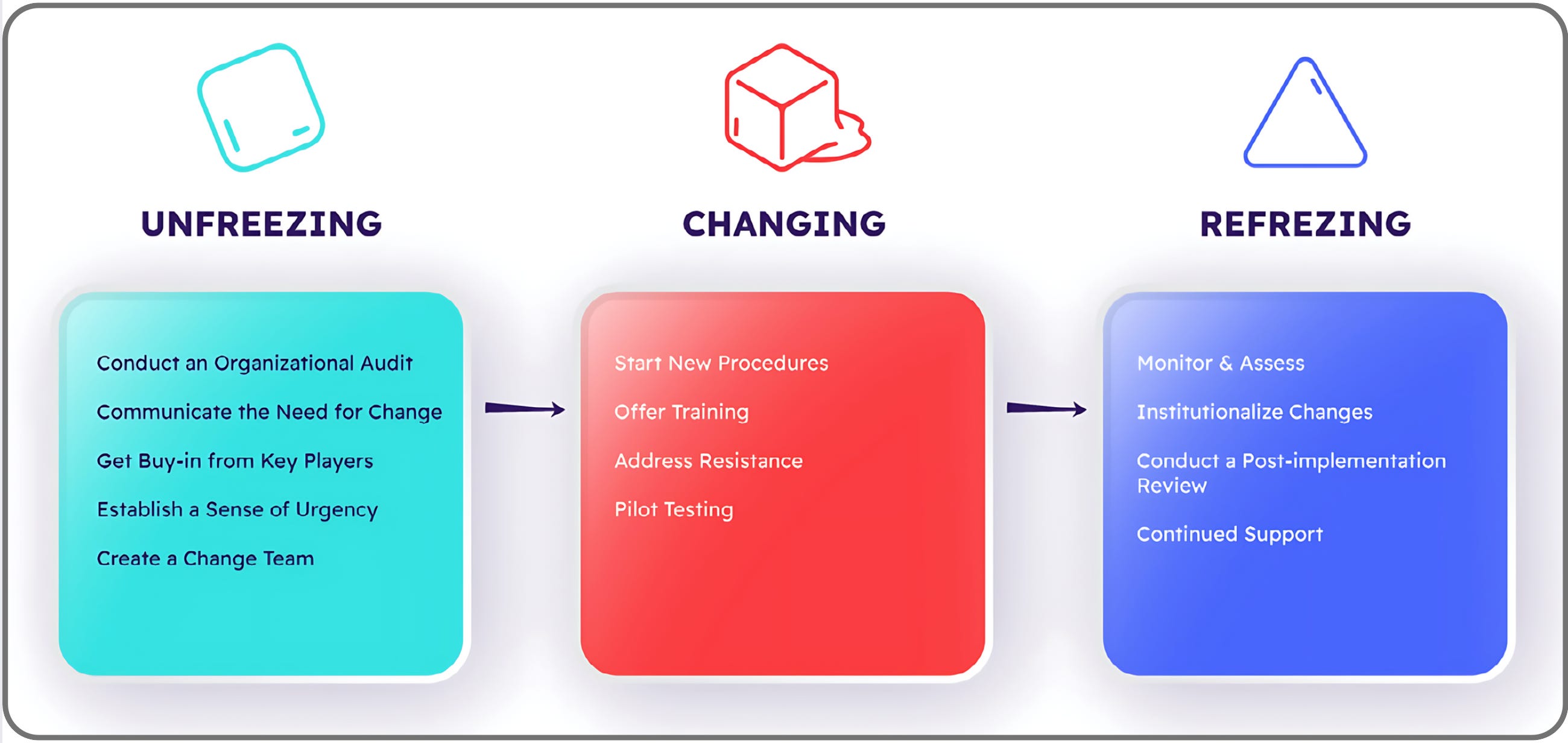
Lewin’s approach divides the process of change into three basic phases:
Unfreezing: The first stage in implementing any change is to ‘unfreeze’ or dismantle the existing status quo. To achieve this, it is necessary to contest and overcome accepted conventions and behaviours.
Employees are made aware of the need for change during the preparation phase, frequently by providing examples of the negative aspects of the status quo (Lewin, 1947).Changing: This phase, which is also known as the “transition,” entails putting the change into effect. New actions, procedures, and modes of thought are presented. At this point, support, education, and communication are essential. Making sure that stakeholders understand the change and have access to the tools they need to adjust is crucial (Lewin, 1951).
Refreezing: Following the integration of the modification, the organisation moves into the ‘refreezing’ stage. Stabilising the change and ensuring that it gets ingrained in organisational culture are the goals of this phase. The organisation regains a sense of stability as the new behaviours and procedures become established (Lewin, 1947).
Lewin’s paradigm emphasises the notion that transformation is a process rather than an event. This model’s simplicity and clarity have made it a mainstay in the field of change management, and its fundamental ideas still inform numerous contemporary change techniques.
It’s important to remember that while Lewin’s model provides a linear development through the stages, this evolution may not always be obvious in the context of a real-world organisational structure. Before they achieve the desired change outcome, some organisations may find themselves moving back and forth between stages (Burnes, 2004).