MAKING AI TRANSFORMATION WORK
Start here → Actionable AI prompts designed to successfully implement AI technologies


This article provides actionable AI prompts designed to help consultants, change management professionals, and organizational leaders successfully implement AI technologies within their organizations. Drawing from research-backed strategies and proven methodologies for managing technological transitions, these prompts will help you navigate the complex human aspects of AI transformation.
The prompts are organized into key strategic areas that address common challenges in AI adoption, from assessing organizational readiness to sustaining long-term change. By leveraging these prompts with an AI assistant, you’ll be able to develop customized strategies, communication plans, and implementation frameworks that address the unique needs of your organization or clients.
Whether you’re at the beginning of your AI implementation journey or seeking to improve ongoing transformation efforts, these prompts will help you develop approaches that prioritize both technological excellence and human adaptation.
CATEGORIES
____
Assessing Organizational Readiness for AI
1. Create an AI Readiness Assessment
Act as an organizational development consultant specializing in technology adoption.
Design a comprehensive AI readiness assessment questionnaire with 15-20 questions
covering the five key dimensions of AI readiness: leadership commitment, cultural
openness, workforce capability, process flexibility, and technology infrastructure.

For each dimension, include 3-4 questions rated on a 1-5 scale, where 1 means
“not ready” and 5 means “very ready.” Include scoring guidelines that help interpret
the results and provide targeted recommendations based on different scoring ranges.

Here is information about my organization: [Insert details about company size,
industry, current technology adoption level, and previous change initiatives].
2. Analyze Resistance Patterns
Act as an organizational psychologist specializing in technology adoption. Based on these observations of employee behaviors toward our upcoming AI implementation [Insert specific behaviors, comments, or resistance patterns you’ve observed], analyze the underlying concerns and categorize them into fear of job replacement, cognitive overload, or identity threat. For each category identified, provide specific strategies to address these concerns through communication, training, and implementation approaches.
3. Identify AI Champions
Act as a change management expert. Create a framework for identifying potential AI champions within our organization. Outline the key characteristics, skills, and influence patterns to look for, and develop a structured interview guide with 7-10 questions to help evaluate candidates. Also provide guidance on how to approach and recruit these champions once identified. Our organization structure includes: [Insert details about departments, team structures, and key roles].
4. Map Department-Specific Resistance
Act as a change management consultant. Create a resistance mapping matrix for our organization that outlines the likely resistance patterns specific to each of these departments: [Insert list of departments receiving AI implementation]. For each department, analyze their potential concerns based on their core functions, current workflow, and professional identity. Include a column for recommended approaches tailored to each department’s specific context and concerns.
5. Leadership Readiness Assessment
Act as an executive coach specializing in digital transformation. Design an assessment to evaluate our leadership team’s readiness to champion AI implementation. Include questions that measure their understanding of AI capabilities, comfort with technology, communication skills around change, and willingness to visibly support transformation. Provide a scoring rubric and recommendations for leadership development based on the assessment results. Our leadership team consists of: [Insert details about the leadership team structure, backgrounds, and previous experience with technology initiatives].
Building Leadership Alignment and Support
6. Design Leadership Alignment Workshop
Act as a transformation consultant. Design a 3-hour leadership alignment workshop agenda to create a shared vision for our AI implementation. Include specific exercises that will help leaders articulate their concerns, understand the cost of inaction, define success metrics, and commit to specific support actions. For each agenda item, provide detailed facilitation notes and expected outcomes. The key stakeholders who will attend include: [Insert information about leadership team members and their roles].
7. Create Executive Communication Strategy
Act as a change communication strategist. Develop a 90-day executive communication plan for our AI implementation that outlines how our leadership team should communicate about the initiative. Include timing, key messages, communication channels, and specific talking points for different phases of the implementation. Address how to handle challenging questions about job security, productivity expectations, and error management. Here’s information about our planned implementation: [Insert timeline, scope, and objectives of the AI implementation].
8. Develop Leadership Success Metrics
Act as a business intelligence consultant. Create a dashboard framework for tracking AI transformation success metrics that our executive team should monitor. Include both technical adoption metrics and behavioral change indicators. For each metric, provide a definition, data collection method, recommended tracking frequency, and guidelines for interpretation. Our implementation goals include: [Insert specific objectives, expected benefits, and timeframe for the AI implementation].
9. Script Difficult Leadership Conversations
Act as an executive communication coach. Prepare scripts for our leadership team to address three common difficult conversations about AI implementation: (1) responding to fears about job elimination, (2) addressing concerns about AI making mistakes, and (3) explaining why this implementation is different from previous failed technology initiatives. For each scenario, provide a conversation framework, key talking points, and specific language to use and avoid. Our organization’s context includes: [Insert information about previous technology implementations, current workforce concerns, and industry pressures].
10. Create ROI Analysis Framework
Act as a business transformation consultant. Develop a comprehensive ROI analysis framework for our AI implementation that goes beyond technical metrics to include change management value. Include sections for quantifying productivity gains, error reduction, employee experience improvements, and competitive advantage. Provide specific formulas and measurement approaches for each category that our leadership can use to justify continued investment. Our implementation involves: [Insert details about the specific AI tools being implemented, affected workflows, and expected benefits].
Developing Effective Communication Strategies
11. Design Communication Campaign Using CLEAR Method
Act as a change communication expert. Using the CLEAR communication method (Clarify purpose, Link to their world, Explain what changes, Address concerns proactively, Reinforce partnership), create a complete communication campaign for our AI implementation. Include 5-7 key messages that should be consistently communicated, sample announcements for different channels, and a timeline for when each communication should be released. Our implementation affects these stakeholder groups: [Insert details about affected teams, their current workflows, and potential concerns].
12. Create Role-Specific Value Messaging
Act as a communication strategist. Develop tailored value proposition messages for each of these roles affected by our AI implementation: [Insert list of specific job roles]. For each role, create messaging that addresses: (1) how AI will enhance their specific work, (2) what skills will become more valuable, and (3) how success will be measured in their evolved role. Include concrete examples and metaphors that will resonate with each role’s professional identity.
13. Develop FAQ Document
Act as a knowledge management specialist. Create a comprehensive FAQ document for our AI implementation that addresses the 15-20 most likely questions and concerns. Organize questions into categories (technical, workflow, skills, support, security, etc.) and provide clear, honest answers that acknowledge concerns while building confidence. Include both factual information and empathetic framing. Our implementation context includes: [Insert details about the AI tools, timeline, training plan, and support resources].
14. Create Success Story Template
Act as a content strategist. Design a structured template for collecting and sharing success stories from early AI adopters in our organization. Include specific questions to ask adopters, a format for presenting their experiences, and guidance on how to distribute these stories for maximum impact. The template should capture both practical benefits and emotional journeys. Our initial implementation focuses on: [Insert information about pilot groups, use cases, and expected benefits].
15. Develop Resistance Response Playbook
Act as a change management expert. Create a resistance response playbook for our team leaders that helps them identify and address different types of AI resistance. Include a typology of resistance behaviors (active vs. passive, technical vs. emotional), response scripts for common resistance scenarios, and escalation protocols for persistent resistance. Provide guidance on when to address concerns individually versus in group settings. Our organizational context includes: [Insert information about team dynamics, previous change responses, and specific AI concerns expressed].
Designing Effective Training and Support Systems
16. Design Progressive Exposure Training Plan
Act as an instructional designer specializing in technology adoption. Create a progressive exposure training plan for our AI implementation that gradually introduces complexity. Break down the training into four phases (awareness, guided practice, supported independence, and full integration) with specific activities and support resources for each phase. Include timelines, success criteria for advancement, and contingency planning for learners who struggle. The AI tools we’re implementing include: [Insert details about the specific AI capabilities, interfaces, and use cases].
17. Develop Peer Mentoring Framework
Act as a learning and development specialist. Design a peer mentoring program to support our AI implementation. Include selection criteria for mentors, a training plan to prepare them, a structured mentoring process with specific activities and touchpoints, and metrics to evaluate the program’s effectiveness. Provide templates for mentoring sessions and progress tracking. Our organizational structure includes: [Insert information about team distribution, reporting relationships, and collaboration patterns].
18. Create Safe Practice Scenarios
Act as an instructional designer. Develop 7-10 realistic practice scenarios that allow our team to safely experiment with the new AI tools without affecting real work. Each scenario should present a common work situation, provide sample data to use, include step-by-step instructions for using the AI tool, and conclude with reflection questions about the experience. The scenarios should progress from simple to complex. Our AI tool will be used for: [Insert information about specific work processes, current workflows, and AI capabilities].
19. Design Support Escalation Process
Act as a service design expert. Create a multi-tiered support escalation process for our AI implementation that clarifies how users should seek help when they encounter difficulties. Map out the different support levels, response time expectations, issue categorization system, and documentation requirements. Include templates for issue reporting and resolution tracking. Our support resources include: [Insert information about available technical support, change champions, and training resources].
20. Develop Learning Verification Assessment
Act as an educational assessment expert. Design an assessment approach to verify that employees have developed the necessary skills to use our new AI tools effectively. Include a mix of knowledge verification questions, practical demonstrations, and reflective elements. Provide a rubric for evaluating proficiency and recommendations for additional support based on assessment results. The key skills needed for our AI tools include: [Insert details about specific technical skills, decision-making capabilities, and collaboration requirements].
Implementing a Phased Rollout Approach
21. Design Pilot Group Selection Framework
Act as a change management consultant. Create a framework for selecting the ideal pilot group for our AI implementation. Include selection criteria that balance early adopters with potential resistors, critical success factors for the pilot phase, and specific metrics to track during the pilot. Provide a template for documenting pilot learnings and translating them into adjustments for the full rollout. Our organization includes these potential pilot groups: [Insert information about different teams, their work characteristics, and technology readiness].
22. Create Wave-Based Rollout Plan
Act as an implementation strategist. Design a wave-based rollout plan for our AI implementation that sequences the deployment across different departments or teams. Include criteria for determining the optimal sequence, timing between waves, learning mechanisms between waves, and critical path dependencies. Provide a visual timeline and decision points for evaluating readiness to proceed with each wave. Our organization structure and implementation scope includes: [Insert details about departments, geographic distribution, and implementation components].
23. Develop Go/No-Go Decision Framework
Act as a project governance expert. Create a structured Go/No-Go decision framework for each phase of our AI implementation. Include specific criteria across technical readiness, user readiness, support readiness, and risk management that must be met before proceeding to the next implementation phase. Provide a scoring system and meeting agenda template for making these decisions collaboratively. Our implementation timeline includes these key phases: [Insert information about planned implementation stages and milestones].
24. Design Implementation Command Center
Act as a transformation management expert. Design a comprehensive implementation command center structure for our AI rollout. Include daily/weekly operating rhythms, team roles and responsibilities, information display systems, decision-making protocols, and communication channels. Provide templates for status reporting, issue tracking, and risk management. Our implementation governance includes: [Insert details about project governance, stakeholder groups, and reporting requirements].
25. Create Contingency Planning Framework
Act as a risk management consultant. Develop a contingency planning framework for our AI implementation that identifies potential failure points and prepared responses. Include sections for technical failures, adoption resistance, support overwhelm, and unexpected business disruptions. For each category, provide a structured approach to identifying early warning signs, immediate containment actions, and recovery strategies. Our implementation risks include: [Insert information about specific technical dependencies, user concerns, and business constraints].
Building Trust and Managing Resistance
26. Develop Trust-Building Playbook
Act as a change psychology expert. Create a trust-building playbook for our AI implementation that outlines specific activities and approaches to build confidence in the AI system. Include strategies for demonstrating system reliability, ensuring human oversight, providing transparency about limitations, and showing how feedback influences improvements. Provide a timeline for trust-building activities aligned with different implementation phases. Our specific trust challenges include: [Insert information about past technology initiatives, current skepticism factors, and specific AI concerns].
27. Create Resistance Management Toolkit
Act as a behavioral change expert. Develop a resistance management toolkit for our team leaders that helps them recognize and respond to different forms of AI resistance. Include a resistance typology, observation guides, response scripts for different scenarios, and guidelines for when to escalate resistance issues. Provide specific approaches for addressing emotional, identity-based, and practical concerns. Our team dynamics include: [Insert information about team composition, influence patterns, and previous change responses].
28. Design Recognition and Gamification Strategy
Act as an employee engagement specialist. Create a recognition and gamification strategy to encourage AI adoption and celebrate progress. Include different types of recognition for different adoption milestones, ideas for friendly team competitions, visibility mechanisms for successful adopters, and celebration moments throughout the implementation journey. Our organizational culture around recognition includes: [Insert information about current recognition practices, motivational preferences, and cultural considerations].
29. Develop Identity Transition Workshop
Act as a professional development facilitator. Design a 2-hour workshop that helps employees reframe their professional identity in relation to AI assistance. Include exercises that explore current identity anchors, transferable strengths, emerging value opportunities, and future vision development. Provide facilitation notes, worksheets, and follow-up activities. Our affected roles include: [Insert information about job roles, key responsibilities, and how AI will change their work].
30. Create Emotional Journey Mapping Exercise
Act as an employee experience designer. Develop an emotional journey mapping exercise that helps teams anticipate and plan for the emotional aspects of AI adoption. Include a mapping template that tracks emotions across implementation phases, guidance for facilitating conversations about emotional responses, and strategies for addressing challenging emotions constructively. Our implementation timeline includes: [Insert key milestones and transition points in your AI implementation].
Measuring Success and Ensuring Sustainability
31. Design Adoption Metrics Dashboard
Act as a data visualization expert. Create a comprehensive adoption metrics dashboard for tracking the success of our AI implementation. Include technical metrics (usage rates, feature utilization), behavioral metrics (workflow integration, time savings), and sentiment metrics (confidence levels, satisfaction). For each metric, provide data collection methods, visualization recommendations, and interpretation guidelines. Our key success indicators include: [Insert specific goals and objectives for the AI implementation].
32. Develop Continuous Improvement Framework
Act as a process improvement consultant. Design a continuous improvement framework for our AI implementation that establishes ongoing mechanisms for gathering feedback, identifying improvement opportunities, and implementing enhancements. Include regular review cycles, improvement prioritization criteria, and governance processes for managing the improvement pipeline. Our support structure includes: [Insert information about ongoing support resources, feedback channels, and improvement capabilities].
33. Create Capability Transfer Plan
Act as a knowledge management consultant. Develop a structured capability transfer plan that enables our organization to gradually take ownership of the AI change management process. Include skill development roadmaps for internal team members, documentation requirements, shadowing and coaching approaches, and readiness assessment criteria. Our internal capability development goals include: [Insert information about desired internal capabilities, timeline for development, and available resources].
34. Design Long-term Sustainability Assessment
Act as a sustainability consultant. Create an assessment framework for evaluating the long-term sustainability of our AI implementation six months and one year after full deployment. Include evaluation criteria across technical performance, user adoption, business impact, and organizational integration. Provide a structured methodology for conducting the assessment and acting on findings. Our long-term success criteria include: [Insert information about expected benefits, integration goals, and evolution expectations].
35. Develop Success Story Collection System
Act as a knowledge management specialist. Design a system for systematically collecting, verifying, and sharing success stories from our AI implementation. Include interview protocols, verification standards, story formatting templates, and distribution channels. Create a classification system that organizes stories by department, use case, and benefit type to maximize relevance for different audiences. Our communication channels include: [Insert information about internal communication platforms, meeting structures, and knowledge sharing practices].
Leading Transformational Change
36. Design Leadership Coaching Program
Act as an executive coach specializing in technological transformation. Create a 90-day leadership coaching program to help our executives become effective AI transformation leaders. Include assessment tools, development activities, reflection exercises, and progress measurements across key leadership capabilities like change communication, resistance management, and vision articulation. Provide session outlines and supporting materials. Our leadership team includes: [Insert information about leadership team composition, styles, and development needs].
37. Develop Change Narrative Framework
Act as a strategic communication consultant. Create a structured framework for developing a compelling change narrative around our AI implementation. Include sections for articulating the case for change, painting a vision of the future, acknowledging the journey challenges, and emphasizing commitment to support. Provide examples of effective language, storytelling elements, and visualization approaches. Our organizational context includes: [Insert information about company history, values, and current business challenges].
38. Create Stakeholder Engagement Strategy
Act as a stakeholder management expert. Develop a comprehensive stakeholder engagement strategy for our AI implementation. Include stakeholder mapping methodology, engagement approaches tailored to different influence/interest levels, communication preferences analysis, and engagement tracking systems. Provide templates for stakeholder analysis and engagement planning. Our key stakeholder groups include: [Insert information about different stakeholder groups, their interests, and influence levels].
39. Design Cultural Evolution Roadmap
Act as an organizational culture consultant. Create a 18-month cultural evolution roadmap that supports our AI transformation by gradually shifting key cultural elements. Identify 4-5 critical cultural attributes that need to evolve, baseline assessment approaches, specific interventions to shift each attribute, and measurement methods to track progress. Include milestone markers and adjustment points. Our current cultural characteristics include: [Insert information about organizational culture, values, and behavioral norms].
40. Develop Transformation Story Retrospective
Act as an organizational learning consultant. Design a structured retrospective process to document our AI transformation journey, capture key learnings, and create a playbook for future technology adoptions. Include documentation frameworks, interview protocols, analysis methods, and knowledge packaging approaches. Provide a timeline for conducting the retrospective alongside the implementation. Our knowledge management goals include: [Insert information about how you want to use the learnings, who should benefit, and what outcomes you expect].
IMPLEMENTATION STRATEGY
____
Getting Started with These Prompts
To effectively use these prompts with an AI assistant and achieve your AI transformation goals:
1. Begin with assessment prompts: Start with the organizational readiness assessment prompts to understand your current state and identify priority areas. This initial data will inform which subsequent prompts will be most valuable.
2. Customize before submitting: Always take time to customize the bracketed sections with specific information about your organization, implementation plans, and context. The more specific information you provide, the more tailored and actionable the AI’s response will be.
3. Build sequentially: These prompts are designed to follow a logical implementation sequence. Start with foundational elements (readiness, leadership alignment) before moving to execution elements (communication, training, implementation).
4. Iterate and refine: Use the AI assistant to help you refine initial outputs. For example, after receiving a communication plan, you might follow up with: “This is helpful, but can you adapt this plan to address more specific concerns about job security that our finance team has expressed?”
5. Combine outputs strategically: The responses from individual prompts should work together as part of your comprehensive transformation approach. Look for opportunities to cross-reference and integrate outputs from different prompts.
Maximizing the Value of AI Assistance
To get the most value from your AI assistant when implementing these transformation strategies:
1. Provide context about previous work: When moving from one prompt to another, briefly summarize what you’ve already developed so the AI can build upon previous outputs rather than creating disconnected elements.
2. Request specific formats: If you need deliverables in particular formats (slide decks, one-pagers, workshop agendas), specify this in your request. The AI can structure information in the most useful format for your specific needs.
3. Ask for implementation guidance: After receiving a framework or plan, ask follow-up questions about implementation challenges or adaptation strategies: “What are the three most common pitfalls when implementing this type of training approach, and how can we avoid them?”
4. Seek simplification when needed: If the AI provides something too complex for your context, ask for a simplified version: “This is comprehensive but might be too complex for our small organization. Can you provide a streamlined version that maintains the core elements but requires fewer resources to implement?”
5. Request examples and templates: For any strategy or framework, ask the AI to provide concrete examples, templates, or scripts that make abstract concepts actionable: “Can you provide a sample script for how a manager would introduce this AI tool to their team using the CLEAR framework?”
Phased Implementation Approach
For most organizations, a phased approach to using these prompts will yield the best results:
Phase 1: Assessment and Foundation (Weeks 1-4)
Use readiness assessment prompts to understand your starting point
Develop leadership alignment and commitment strategies
Create your communication foundation and resistance management approaches
Phase 2: Planning and Preparation (Weeks 5-8)
Design your training and support systems
Develop your phased implementation approach
Create your trust-building and resistance management toolkits
Phase 3: Implementation and Adjustment (Weeks 9-16)
Execute your communication campaign
Implement training and support systems
Collect feedback and make adjustments
Phase 4: Sustainability and Evolution (Ongoing)
Measure adoption and impact
Implement continuous improvement mechanisms
Transfer capabilities to internal teams
By following this structured approach to using the prompts, you’ll develop a comprehensive transformation strategy that addresses both the technological and human aspects of AI implementation. Remember that successful transformation is not just about the quality of your plans but about how effectively you listen, adapt, and support people through change. Use these prompts as living tools that evolve as you learn more about your organization’s specific needs and responses to AI implementation.
PROSCI - ADKAR aligned approach:
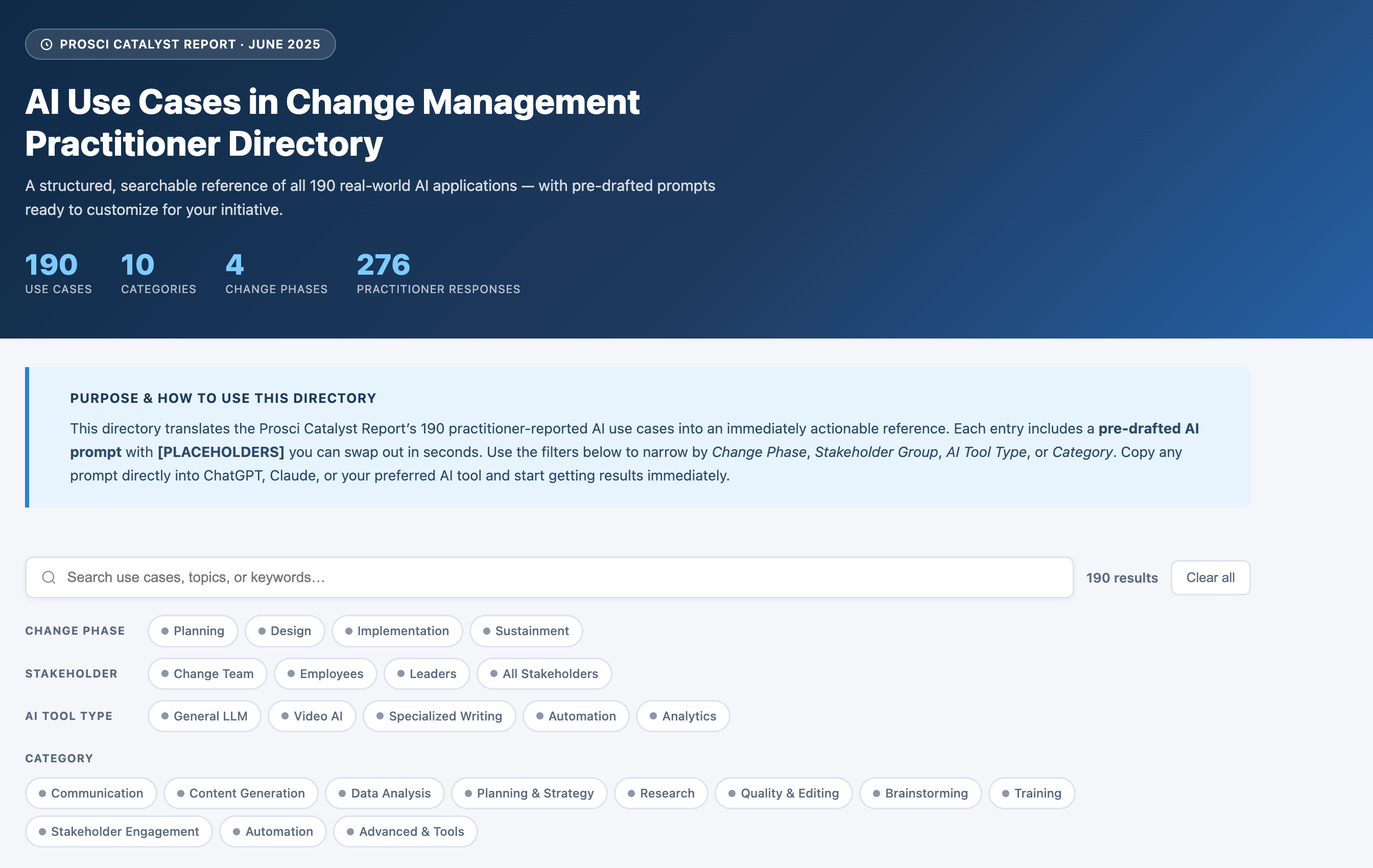
AI Use Cases in Change Management Practitioner Directory below.