Making Your First Cryptocurrency Purchase
Guide designed to help you make your first cryptocurrency purchase with clear steps for buying safely and protecting their digital assets.

Buying cryptocurrency for the first time can feel overwhelming. You’ve likely heard about Bitcoin and other digital currencies for years, but the actual process of purchasing them might seem complex and intimidating. The good news is that acquiring cryptocurrency has become significantly more straightforward and secure than in its early days.
This guide transforms the knowledge into a step-by-step process that will take you from complete beginner to successfully completing your first cryptocurrency purchase. We’ll cover everything from choosing the right exchange to securing your new digital assets after purchase.
The cryptocurrency market represents a fundamental shift in how we think about money and financial freedom. This technology is revolutionizing finance, contracts, and digital ownership. Taking your first step into cryptocurrency ownership is not just about potential investment returns, it’s about participating in a technological revolution that’s reshaping our economic landscape.
Let’s break down this process into manageable steps that anyone can follow, regardless of technical background.
Understand What You’re Buying
Before making any purchase, it’s essential to have a basic understanding of what cryptocurrency is and the differences between major options.
The Main Types of Cryptocurrency
Bitcoin (BTC): The first and most well-known cryptocurrency. Often called “digital gold” because it has a limited supply (only 21 million Bitcoin will ever exist). This scarcity is why many investors see it as a way to protect against inflation.
Ethereum (ETH): More than just digital money, Ethereum functions as a computing platform that runs programs called smart contracts. These contracts automatically execute agreements without middlemen, making Ethereum valuable for applications beyond simple money transfers.
Stablecoins: Unlike most cryptocurrencies that fluctuate in value, stablecoins maintain a steady price, usually pegged to one dollar. Popular options include USDC and USDT (Tether). They provide the benefits of cryptocurrency technology with the stability of traditional currency.
Altcoins: This category includes thousands of other cryptocurrencies beyond Bitcoin and Ethereum. Each offers something different—faster transactions, enhanced privacy, or applications in specific industries. As a beginner, it’s recommended to start with established cryptocurrencies before exploring alternatives.
Key Concepts to Understand
Market Capitalization: The total value of a cryptocurrency’s supply. Larger market caps generally indicate more stability and acceptance.
Liquidity: How easily you can buy or sell a cryptocurrency without affecting its price. Higher liquidity means easier trading.
Beginner’s Tip: For your first purchase, consider starting with Bitcoin or Ethereum. These have the largest market capitalizations and highest liquidity, making them generally safer first investments than smaller, more volatile alternatives.
Choose the Right Exchange
Cryptocurrency exchanges are platforms where you can trade regular money (fiat currency) for digital currency. Selecting a reputable exchange is crucial for security and ease of use.
Top Beginner-Friendly Exchanges
1. Coinbase:
Pros: Extremely user-friendly interface, strong security measures, educational resources
Cons: Higher fees than some alternatives
Best for: Complete beginners who prioritize ease of use and security
2. Gemini:
Pros: Strong focus on regulatory compliance, good security
Cons: Available in fewer countries than some competitors
Best for: Security-conscious beginners in supported regions
3. eToro:
Pros: Educational resources, social trading features allowing you to learn from experienced traders
Cons: Not focused exclusively on cryptocurrency
Best for: Those who want to learn while trading
Evaluation Criteria for Choosing an Exchange
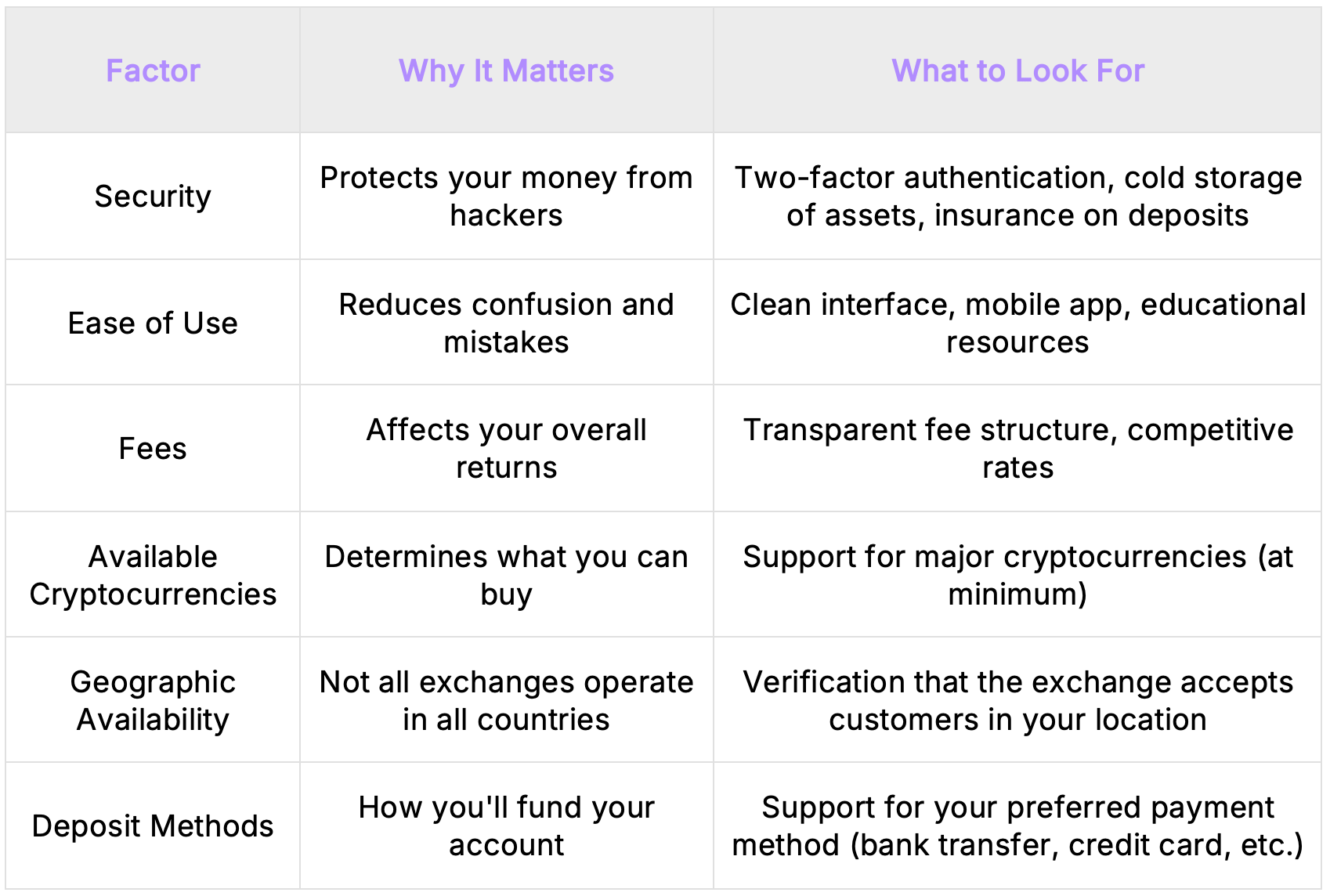
Research Steps Before Committing
1. Check if the exchange is available in your country
2. Read reviews from multiple sources (not just the exchange’s website)
3. Verify the exchange’s regulatory status
4. Investigate its security history (past hacks, response to incidents)
5. Compare fee structures across 2-3 options
Beginner’s Tip: Coinbase remains the most straightforward option for first-time buyers in countries where it operates. Its interface is designed with beginners in mind, and the company follows strict regulations that help protect your funds.
Create and Secure Your Exchange Account
Once you’ve selected an exchange, you’ll need to create an account and implement security measures before making any purchases.
Account Setup Process
1. Visit the exchange website or download their mobile app
○ Ensure you’re on the official website (check the URL carefully)
○ Never click on links from emails claiming to be from exchanges
2. Complete the registration form
○ Use a strong, unique password
○ Provide your email address
○ Accept the terms and conditions (after reading them)
3. Verify your email address
○ Click the verification link sent to your email
○ This confirms you control the email account
4. Enable two-factor authentication (2FA)
○ Download an authenticator app like Google Authenticator or Authy
○ Follow the exchange’s instructions to link the app to your account
○ Store backup codes in a secure location
Identity Verification (KYC Process)
Cryptocurrency exchanges are required by regulations to verify the identity of their users. This process is known as Know Your Customer (KYC) and typically involves:
1. Personal information collection:
○ Full legal name
○ Date of birth
○ Address
○ Phone number
○ Social Security Number or national ID (varies by country)
2. Document verification:
○ Government-issued photo ID (passport, driver’s license)
○ Proof of address (utility bill, bank statement)
○ Selfie or video verification
3. Approval process:
○ Verification can take anywhere from minutes to days
○ You’ll receive notification when approved
Securing Your Exchange Account
1. Use a dedicated email address for cryptocurrency activities
2. Create a strong, unique password that you don’t use anywhere else
3. Enable two-factor authentication (2FA) using an authenticator app rather than SMS
4. Set up withdrawal address whitelisting if available
5. Review account activity regularly for unauthorized actions
Security Note: Two-factor authentication is non-negotiable for cryptocurrency accounts. Even if someone discovers your password, they still can’t access your account without the second authentication factor. This single security feature prevents the vast majority of account takeovers.
Fund Your Exchange Account
Before you can purchase cryptocurrency, you need to add funds to your exchange account. Most exchanges offer several methods for depositing fiat currency.
Common Funding Methods
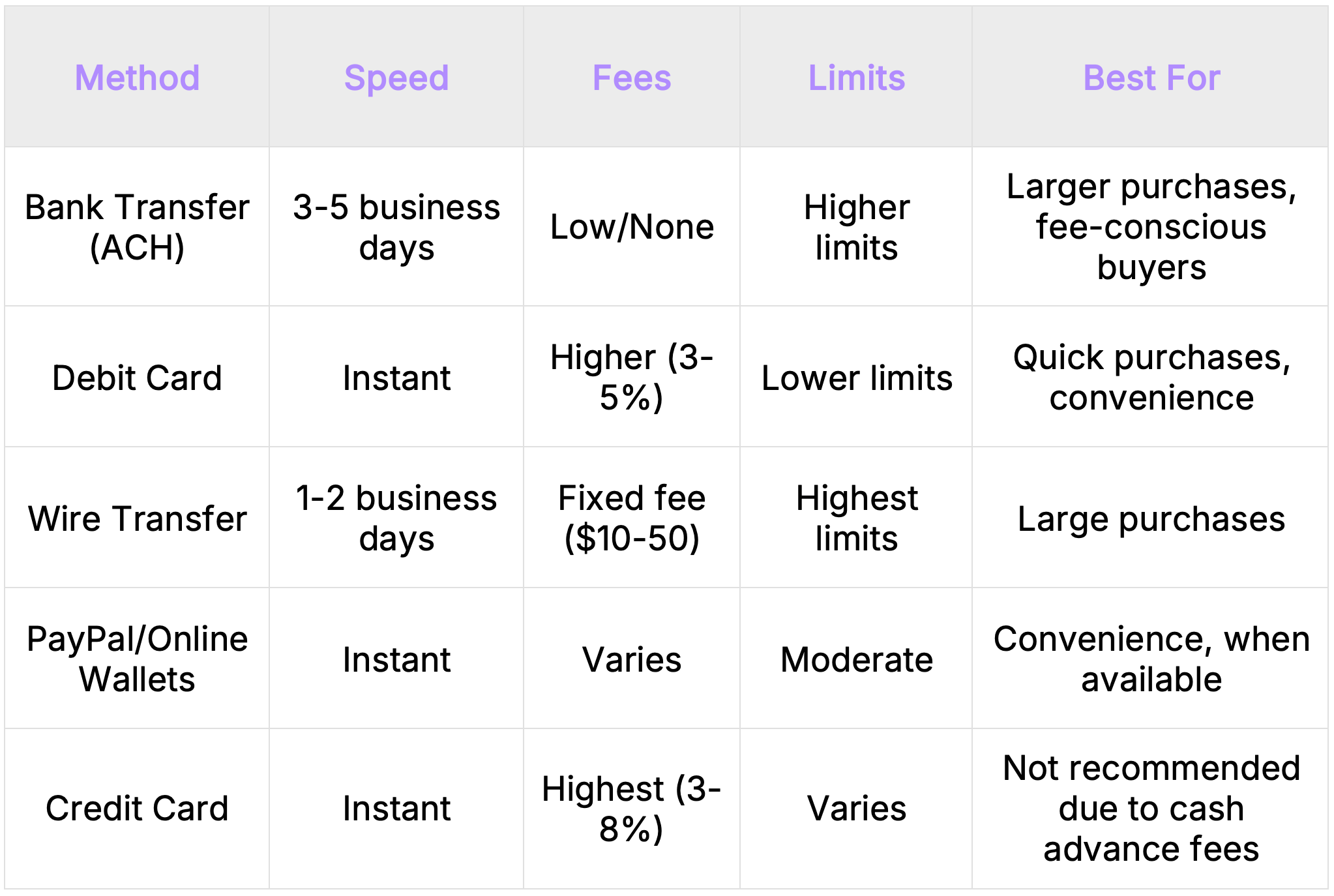
Step-by-Step Deposit Process
1. Navigate to the funding or deposit section of your exchange
○ Look for “Deposit,” “Fund,” or “Add Money” options
2. Select your deposit method
○ Consider the trade-offs between fees, speed, and limits
3. Enter the amount you wish to deposit
○ Start with a small amount for your first purchase
○ Never invest more than you can afford to lose
4. Complete the required information
○ For bank transfers: account and routing numbers
○ For cards: card details, billing address, etc.
5. Confirm the transaction
○ Verify all details before submitting
○ Note any reference numbers provided
6. Wait for funds to appear
○ Timing varies by method (instant to several days)
○ Most exchanges will notify you when funds arrive
Important Considerations
Deposit limits: Exchanges often have daily, weekly, or monthly limits on how much you can deposit
Verification levels: Higher deposit limits may require additional verification steps
Bank restrictions: Some banks block cryptocurrency purchases; check with your bank if you encounter issues
Transaction fees: Be aware of fees from both the exchange and your payment provider
Beginner’s Tip: For your first purchase, consider using a bank transfer for lower fees if you’re not in a hurry, or a debit card for immediate purchasing if you want to buy right away. Avoid credit cards due to their high fees and the risk of debt if investments lose value.
Make Your First Purchase
With your account funded, you’re ready to make your first cryptocurrency purchase. This is typically done through the exchange’s trading interface.
Types of Purchase Options
Most exchanges offer several ways to buy cryptocurrency, each with different levels of complexity:
1. Simple Buy/Sell Interface (recommended for beginners)
○ Select the cryptocurrency you want
○ Enter the amount you wish to buy
○ Review and confirm the transaction
2. Market Order
○ Buys immediately at the current market price
○ Quick but you don’t control the exact price
3. Limit Order
○ Specifies the maximum price you’re willing to pay
○ Only executes if the price reaches your target
○ Gives more control but may never execute if the price doesn’t reach your target
Step-by-Step Purchase Process
1. Navigate to the Buy/Trade section of your exchange
2. Select the cryptocurrency you want to purchase
○ Bitcoin (BTC) or Ethereum (ETH) are recommended for first-time buyers
3. Choose your purchase type
○ For beginners, use the simple buy interface or market order
4. Enter the amount
○ You can specify either:
The amount of cryptocurrency you want (e.g., 0.01 BTC)
The amount of fiat currency you want to spend (e.g., $100)
5. Review the transaction details
○ Conversion rate
○ Fees
○ Total cost
○ Estimated amount of cryptocurrency you’ll receive
6. Confirm your purchase
○ Double-check all details before confirming
○ Once confirmed, market orders cannot be canceled
7. Verify the transaction completed
○ Check your portfolio or transaction history
○ Confirm the cryptocurrency appears in your balance
Dollar-Cost Averaging Strategy
Rather than trying to time the market with a single large purchase, consider using a dollar-cost averaging strategy:
1. Decide on a fixed amount to invest regularly (weekly, monthly)
2. Set up automatic purchases if your exchange offers this feature
3. Continue regardless of price movements
4. This approach reduces the impact of volatility and removes emotional decision-making
Beginner’s Tip: Start small for your first purchase—perhaps $10 to $50—while you get comfortable with the process. Most cryptocurrencies can be purchased in fractions, so you don’t need to buy a whole Bitcoin or Ethereum.
Consider Moving Your Cryptocurrency to a Personal Wallet
After purchasing cryptocurrency, you have a choice: leave it on the exchange or transfer it to your personal wallet. Each option has advantages and considerations.
Exchange Storage vs. Personal Wallet
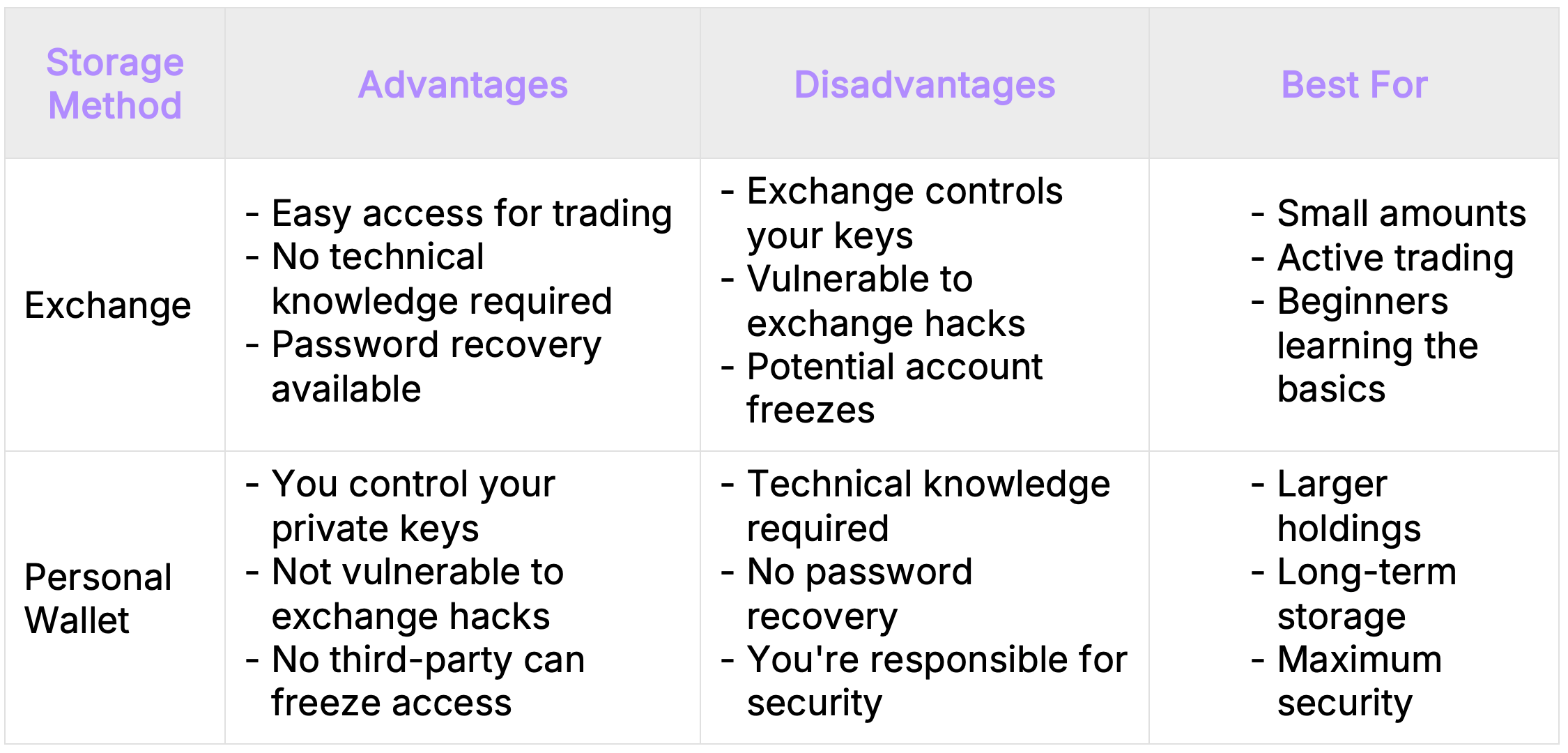
Types of Personal Wallets
1. Hot Wallets (connected to the internet)
○ Mobile apps (e.g., Trust Wallet, Exodus)
○ Desktop software (e.g., Electrum, MetaMask)
○ Web wallets (e.g., MyEtherWallet)
○ Easier to use but less secure than cold storage
2. Cold Wallets (offline storage)
○ Hardware wallets (e.g., Ledger, Trezor)
○ Paper wallets (less recommended nowadays)
○ Maximum security for larger holdings
When to Consider a Personal Wallet
If your holdings exceed $1,000 in value
If you plan to hold long-term (months or years)
If you want maximum control over your assets
If you’re concerned about exchange security
Beginner’s Tip: For your first small purchase, keeping it on a reputable exchange is usually fine while you learn. As your holdings grow or you become more comfortable with cryptocurrency, consider moving to a hardware wallet for improved security.
Document Your Purchase for Tax Purposes
Cryptocurrency transactions have tax implications in most countries. Proper documentation from the beginning will save you significant headaches later.
Essential Information to Record
For each purchase, record:
1. Date and time of the transaction
2. Type of cryptocurrency purchased
3. Amount of cryptocurrency acquired
4. Price paid per unit in your local currency
5. Total cost including fees
6. Purpose of the transaction (investment, specific use, etc.)
7. Transaction ID or hash (can be found in transaction details)
Simple Record-Keeping Methods
1. Spreadsheet tracking:
○ Create a simple spreadsheet with columns for each data point
○ Update with each transaction
○ Back up regularly
2. Dedicated crypto tax software:
○ Services like CoinTracker, Koinly, or TaxBit can connect to exchanges
○ Automatically import transaction history
○ Generate tax reports when needed
3. Exchange reports:
○ Most exchanges allow you to download transaction history
○ Store these reports in a secure, organized location
Tax Considerations to Be Aware Of
In many jurisdictions, cryptocurrency is treated as property, not currency
Buying cryptocurrency with fiat is not typically taxable, but selling, trading, or using it to purchase goods may create taxable events
Tax regulations for cryptocurrency vary by country and change frequently
Consider consulting a tax professional familiar with cryptocurrency if you make significant investments
Record-Keeping Tip: Start documenting your cryptocurrency activity from your very first purchase, even if the amount seems small. Reconstructing transaction histories later is extremely difficult and time-consuming.
Monitor Your Investment and Continue Learning
After making your first purchase, the journey is just beginning. Successful cryptocurrency ownership requires ongoing attention and education.
Responsible Monitoring Practices
1. Check prices periodically, not constantly
○ Cryptocurrency is volatile; daily checking is sufficient
○ Constant price checking can lead to emotional decisions
2. Set up price alerts rather than watching charts
○ Most exchanges and portfolio apps offer customizable alerts
○ This reduces stress while keeping you informed of significant movements
3. Review your portfolio monthly
○ Assess performance
○ Consider rebalancing if necessary
○ Update your documentation
Continuing Education Resources
1. Exchange learning centers:
○ Coinbase Learn
○ Binance Academy
○ Gemini Cryptopedia
2. Online courses:
○ Coursera and edX offer university-backed blockchain courses
○ Upskillist for practical training on emerging trends
3. Community engagement:
○ Reddit communities like r/CryptoCurrency
○ Twitter accounts of respected developers and researchers (not influencers)
○ Discord servers for specific projects you’re interested in
4. Quality news sources:
○ CoinDesk
○ Cointelegraph
○ The Block
Warning Signs to Watch For
Be alert for these red flags that might indicate it’s time to reconsider your strategy:
Dramatic overnight price increases without substantive news
Projects promising guaranteed returns or “risk-free” investments
Pressure to recruit others to buy the same cryptocurrency
Developers or team members with anonymous identities
Excessive focus on price rather than technology or use cases
Learning Tip: Focus on understanding the technology and real-world applications rather than price predictions. The most successful cryptocurrency participants build knowledge about the underlying systems rather than chasing short-term gains.
Common Mistakes to Avoid
Learning from others’ mistakes can save you from costly errors when making your first cryptocurrency purchase.
Top Beginner Mistakes
1. Investing more than you can afford to lose
○ Cryptocurrency remains highly volatile
○ Only use funds you could lose without affecting your financial stability
2. Not double-checking receiving addresses
○ Even a single wrong character sends your money to the wrong place forever
○ Always copy and paste addresses rather than typing manually
○ Verify the first and last few characters after pasting
3. Falling for “get rich quick” promises
○ Scammers target newcomers with unrealistic return promises
○ If it sounds too good to be true, it invariably is
4. Buying based on social media hype
○ Influencers often have undisclosed financial incentives
○ FOMO (fear of missing out) leads to buying at price peaks
5. Neglecting security basics
○ Skipping two-factor authentication
○ Using weak passwords
○ Storing seed phrases digitally
6. Ignoring tax implications
○ Assuming cryptocurrency transactions aren’t taxable
○ Failing to keep proper records from the beginning
7. Sending cryptocurrency to the wrong network
○ Make sure the receiving wallet supports the same blockchain you’re using
○ Many people lose money sending Bitcoin to Ethereum addresses or vice versa
Prevention Tip: Before making any transaction, take a deep breath and double-check all details. The irreversible nature of cryptocurrency transactions means mistakes cannot be corrected by customer service representatives.
Troubleshooting Common Issues
Even when following all the steps correctly, you may encounter challenges during your first purchase. Here’s how to address common problems:
Problem: Your bank blocks the transaction
Solution:
1. Call your bank to inform them the transaction is legitimate
2. Ask if they have a policy regarding cryptocurrency purchases
3. If they won’t allow it, consider switching to a more crypto-friendly bank
4. Try alternative payment methods like ACH transfers instead of cards
Problem: Verification is taking longer than expected
Solution:
1. Check that all documents submitted meet the requirements (clear, complete, valid)
2. Contact customer support through official channels
3. Be patient during high-volume periods when many new users are registering
Problem: Transaction shows as pending for a long time
Solution:
1. Check the network status of the cryptocurrency you’re purchasing
2. Verify if the exchange is experiencing delays (check their status page)
3. For blockchain transactions, you can look up the transaction ID on a blockchain explorer
4. Contact support if the delay exceeds 24 hours without explanation
Problem: You received less cryptocurrency than expected
Solution:
1. Check if the exchange charges fees on purchases (most do)
2. Verify if there was price slippage between when you confirmed and when the order executed
3. Review the exchange’s fee schedule to understand all costs
4. Contact support if the discrepancy exceeds normal fees and slippage
Support Tip: When contacting exchange support, always use official channels accessed directly through the exchange’s website or app. Scammers often create fake support accounts on social media or in search results.
CONCLUSION
Making your first cryptocurrency purchase is a significant milestone in your financial journey. By following this step-by-step guide, you’ve learned how to:
1. Understand the different types of cryptocurrency
2. Choose a reputable exchange that meets your needs
3. Create and secure your exchange account
4. Fund your account through appropriate channels
5. Execute your first purchase effectively
6. Consider storage options for your new digital assets
7. Keep proper records for tax compliance
8. Monitor your investment and continue learning
Remember that cryptocurrency ownership combines cutting-edge technology with personal financial responsibility. The blockchain revolution is already reshaping how money, contracts, and ownership work in our digital society. By taking this first step, you’re not just making an investment—you’re participating in a technological transformation.
Start small, prioritize security, keep learning, and approach cryptocurrency with both optimism about its potential and healthy skepticism about excessive promises. Your journey into cryptocurrency ownership has just begun, and the knowledge you’ve gained will serve you well as blockchain technology continues to evolve and integrate into everyday life.
Action Plan
To consolidate what you’ve learned and move forward confidently:
1. Select an exchange based on your location and needs
2. Complete the verification process with valid identification
3. Enable two-factor authentication immediately after account creation
4. Deposit a small amount ($25-$100) to start with
5. Make your first purchase of Bitcoin or Ethereum
6. Document the transaction in your record-keeping system
7. Research hardware wallets if you plan to increase your holdings
8. Schedule time weekly to learn more about cryptocurrency fundamentals
9. Consider setting up recurring small purchases rather than timing the market
10. Join a reputable community where you can ask questions and learn from others
The most important step is simply to begin. By starting small and following these security-focused guidelines, you’ll gain practical experience that no amount of reading can provide. The cryptocurrency revolution is happening whether you participate or not—this guide ensures you can take part safely, confidently, and with a clear understanding of what you’re doing.