

The McKinsey 7-S Model is a strategic framework that checks the alignment and readiness of seven crucial internal organisational components to support achieving an organisation’s goals. This model, first created in the early 1980s by Tom Peters and Robert Waterman, two consultants from McKinsey & Company, asserts that these seven factors must be coordinated for an organisation to function at its best.
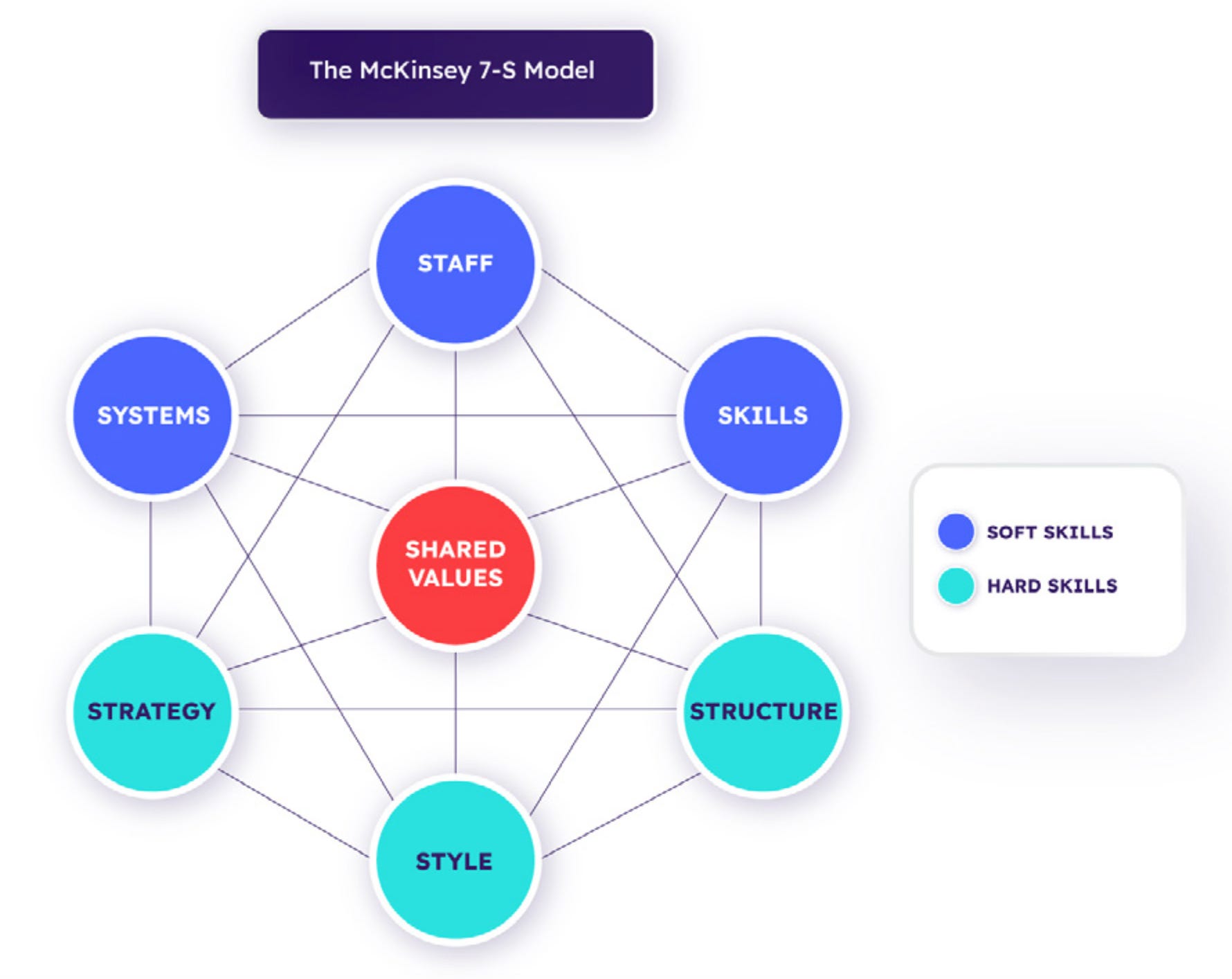
The seven interconnected factors are broken down as follows:
Strategy
The plan was created to keep and expand a competitive advantage over the opposition.
Structure
Who reports to whom and how the organisation is organised. Understanding departments, teams, and reporting hierarchies is required for this.
Systems
Routine tasks and practises used by staff members to complete their work. This includes all processes, workflows, and communication channels, whether formal or informal.
Shared Values
The fundamental principles of the business as initially conceived by the founders and now ingrained in its ethos and culture.
Style
The leadership stance taken by the company, including how decisions are made and how teams are run.
Staff
The people who work for the company and their general abilities. This focuses on the roles, positions, and talent the organisation offers.
Skills
The actual competences and skills of the company’s employees. It answers what the organisation excels at and is renowned for.
The 7-S Model’s strength lies in the fact that it considers both hard (Strategy, Structure, Systems) and soft (Shared Values, Skills, Style, Staff) components. The success of an organisation depends on both sets of criteria, which are interconnected. This approach ensures that no essential component is missed during strategy planning or implementation. It is constructive during times of change because it offers a complete lens through which to see the organisation.
The 7-S Model is a diagnostic tool that helps organisations going through change determine which areas of their organisation are in line with their strategy and which are not, making it an essential tool for developing efficient change management strategies.